Nederlands
  English
  Deutsch
  Español
  Português
  Italiano
  Français
  Hrvatski
  Slovenčina

 Manchester United
 Man City
 Tottenham Hotspur
 Aston Villa
 Newcastle United
 Fulham
 Everton
 West Ham United
 Leeds United
 Ipswich Town
 Nottingham Forest
 Crystal Palace
 Brighton
 Wolves
 Atletico Madrid
 Real Betis
 Real Sociedad
 Villarreal
 Napoli
 Roma
Roma Lazio
Lazio Venezia FC
 Bayer Leverkusen
 RB Leipzig
 Eintracht Frankfurt
 Borussia Dortmund
 AS Monaco
 Olympique Lyonnais
 Marseille
 Chivas
 Tigres UANL
 Monterrey
 Club America
 Cruz Azul
 Pumas UNAM
 Club León
 Ajax
Ajax Sporting
 Boca Juniors
 PSV
PSV Olympiacos
 FC Porto
 Glasgow Rangers
 New York City
 LA Galaxy
 Orlando City
 Bologna FC
 New York Red Bulls
 Scotland
 Norway
 Austria
 Czech
Czech Albania
 Sweden
 Greece
 Ireland
 Turkey
 Yugoslavia
 Hungary
 Ecuador
 Venezuela
 Uruguay
 Chile
Chile Peru
Peru Japan
Japan Australia
 Saudi Arabia
 Senegal
 Cameroon
 Morocco
 Nigeria
 Algeria
 Egypt
Egypt Jamaica
 Guatemala
 Panama
 El Salvador
 Real Madrid
 Barcelona
 Fiorentina
 Celtic
Last updated: oktober 6, 2026
England’s white-shirt tradition reaches back to the 1872 international era. This editorial selection ranks ten tournament-associated designs by their visual appeal and context, not by resale value or measured collector demand.
Two notes on method. First, this is an editorial ranking, and the criteria are set out below — you are free to disagree with the order. Second, everything factual here, from the 1872 origin to the 2026 launch, is sourced at the end of the page.
A jersey listing usually offers a shirt; a kit listing may describe a design or a bundle. Confirm the included pieces rather than treating the two words as a package guarantee.
How This Ranking Works
Every shirt below is judged on three things, in this order:
| Criterion | What it means |
| What it is tied to | The tournament or match the shirt belongs to |
| Design significance | Whether the shirt is remembered for how it looked |
| Availability as a retro | Whether the design can realistically be found today |
Weighting matters. England’s shirt history runs from the 1872 international side to the current Nike-era designs, and only a handful of those shirts are genuinely load-bearing.
The Ten Best England Jerseys at a Glance
| Rank | Shirt | What it is tied to |
| 1 | Home 1996 | EURO 96, hosted in England |
| 2 | Home 1998 | The Beckham and Owen World Cup |
| 3 | Home 2006 | The Lampard, Gerrard and Rooney generation |
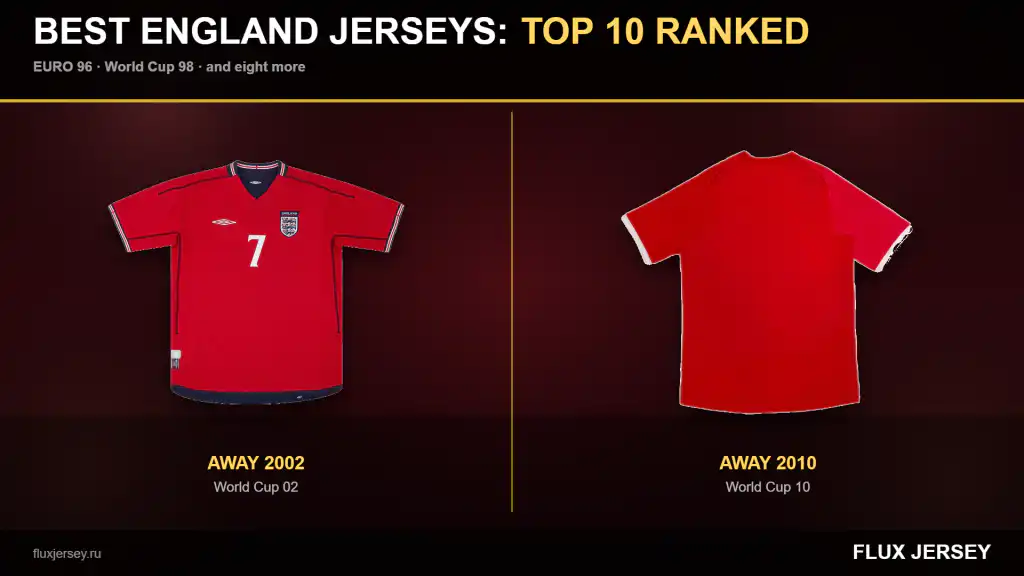
| 4 | Away 2002 | World Cup 2002 away design |
| 5 | Home 2026 | Current kit; Tuchel’s first tournament |
| 6 | Away 2026 | Current away design |
| 7 | Home 2004 | Later Beckham-era home shirt |
| 8 | Away 2010 | Red away shirt of the 2010 cycle |
| 9 | Home 2012 | The last Umbro-era design in this range |
| 10 | Home 2009/10 | Two-season home shirt |
The Ten Best England Jerseys, Ranked
10. Retro England Home Jersey 2009/10
A two-season home shirt from the tail end of the Umbro era. England shirts ran under Umbro from 1984 to 2012, which makes the late-Umbro designs the last of a long manufacturing chapter rather than a single-season design. See the 2009/10 home shirt.
9. Retro England Home Jersey 2012
The final Umbro home shirt before Nike took over in 2013, and the most recent design in this retro range. If you are building a set that runs from the 1990s to the present, this is where the Umbro sequence ends. See the 2012 home shirt.
8. Retro England Away Jersey World Cup 2010
The red away design adds a different colour to this selection of England shirts. Its editorial rank is not based on production numbers or verified secondhand scarcity. See the 2010 away listing.
7. Retro England Home Jersey Euro Cup 2004
The home shirt of the later Beckham years, and the middle design of the 2002–2006 sequence. Named versions exist, including a Beckham #7, which makes this one of the easier shirts in the range to buy in a specific player’s number.
6. England Away Jersey World Cup 2026
The current away shirt, and the more distinctive of the two 2026 designs. Its defining feature is a central badge rather than the offset placement you see on most shirts — a detail that is visible in any clear photograph, which makes it a useful check when you are looking at a listing. See the 2026 away jersey.
5. England Home Jersey World Cup 2026
The current home shirt, in white, with a distinct collar and a fabric print across the body. Nike lists the colourway as White / Speed Red / Obsidian / Obsidian.
It ranks above most current shirts for one reason: the 2026 tournament was England’s first major tournament under head coach Thomas Tuchel, with Harry Kane as captain. A kit tied to the start of a manager’s era tends to be remembered longer than a mid-cycle refresh. See the 2026 home jersey, or the player version if you want the tighter match-day cut.
4. Retro England Away Jersey World Cup 2002
The 2002 away design is an alternative to the white home shirt. Available name-and-number options should not be confused with the tournament squad: The FA confirms Gerrard missed the 2002 World Cup through injury.
That tournament cycle is worth knowing about for a different reason: England’s qualification turned on a 93rd-minute free kick from Beckham against Greece at Old Trafford, which finished 2-2 and sent England to the World Cup. The 2002 home shirt carried a red vertical stripe in the crest area, which is one of the small design details that helps date a shirt from this period.
3. Retro England Home Jersey World Cup 2006
The shirt of the Lampard, Gerrard and Rooney generation — the squad that most people mean when they talk about England’s “golden generation”. Named versions are widely available, including Lampard #8, Gerrard #4 and Rooney #9.
It ranks this high because of the squad rather than the design. Shirts from this era are also among the most reproduced, so check carefully which version you are looking at.
2. Retro England Home Jersey World Cup 1998
The 1998 home design combines white with red and navy detailing. Check the collar, side panels and badge against clear photographs of the selected listing; this editorial position is not a claim that it has better documentation or a higher resale value than the other shirts.
That tournament was the Beckham and Owen World Cup, and it is the shirt most people picture when they picture England in the late 1990s. Named versions include Beckham #7, Shearer #9 and Owen #20, alongside the plain home shirt.
1. Retro England Home Jersey Euro Cup 1996
The highest-ranked shirt on this list, and the one with the strongest claim to the top spot.
EURO 1996 was hosted in England, making the home shirt a direct reference to that tournament. England also staged matches during EURO 2020, so 1996 should not be described as the only European Championship played on home soil.
For a EURO 1996 reference, the Gascoigne #8 listing and plain home design are relevant comparisons. Beckham’s senior debut came later in September 1996, as recorded by The FA; a Beckham print on this design is not evidence of a EURO 1996 appearance.
Two Shirts Worth Knowing About
Two other designs provide context beyond the ten selected listings.
The light-blue third design. A third shirt can offer a different colour and styling choice from the white home and red away designs. No production total or resale-demand dataset has been used to assign scarcity or value here.
The 1872 shirt. The National Football Museum documents a shirt from the first official international, England against Scotland in 1872. It gives the white-shirt tradition a much earlier reference point than 1896.
What to Check Before Buying a Retro England Shirt
When shopping for a retro design, distinguish the design’s tournament date from the manufacture date of the garment being sold.
- Confirm the product being offered. An original period shirt and a newly made shirt based on its design are different purchases. A retro label alone does not establish manufacture date, provenance or licensing status.
- Match the shirt to its manufacturer era. England shirts ran Umbro from 1954 to 1961, Bukta from 1962 to 1965, Umbro again from 1966 to 1973, Admiral from 1974 to 1982, Umbro from 1984 to 2012, and Nike from 2013 onwards. A shirt described as a 1978 design with an Umbro mark does not add up.
- Check the size against the size guide, not the label. Older shirts were cut differently, and a labelled size from 1998 does not map cleanly onto a labelled size today. Measure a shirt you already own and compare.
For the wider version question — how a player version differs from a fan version in cut and sizing — we cover that separately in our England kit buying guide.
England Kit FAQ
What colour is the England home kit? White is the established home-shirt colour, with the tradition documented in the 1872 era. The 2026 away shirt is red with a centrally placed badge.
When did England first wear a shirt? The earliest documented shirt is a heavy wool one worn in 1872, in the world’s first official international match against Scotland at Hamilton Crescent in Glasgow. It is held by the National Football Museum.
Who made England’s kits? Umbro from 1954 to 1961, Bukta from 1962 to 1965, Umbro from 1966 to 1973, Admiral from 1974 to 1982, Umbro from 1984 to 2012, and Nike from 2013.
Which England shirt should a collector choose? Start with the tournament or design that matters to you, then verify the actual garment’s condition and provenance. Our ranking is editorial; it does not establish the most valuable or rarest shirt.
Are England retro shirts still made? Yes, and that is the main thing to watch when buying. Modern reproductions of older designs are widely sold and are a different product from an original garment of that year.
Where to Start
Where can you buy an England jersey? Start with the specific shirt you want rather than with a shop, then check that one listing against the manufacturer era, the size guide and the seller’s policies — the three checks above are the sequence this article has walked through.
A note on who is writing this. Flux Jersey sells England shirts, including the retro items linked below. The design and tournament facts in this article are sourced from the organisations credited at the end. The ranking is editorial, and the advice is written to be useful whether or not you buy from us.
If you want the current design, start with the England home jersey and the England away jersey. If you are shopping for an earlier era, our retro England range runs from the 1996 European Championship shirt through to 2012, including named versions.
Whatever you choose, check the size guide on the specific product page and read the shipping policy and returns policy before ordering.
Sources
- England Football (The FA) — New Three Lions kit on sale, 20 March 2026
- UEFA — UEFA EURO 2028 and 2032 hosts confirmed, 10 October 2023
- National Football Museum — Collection and The world’s first international football shirt
- Casual Football Shirts Archive — England kit history