English
 Deutsch
 Español
 Português
 Italiano
 Français


 Manchester United
 Man City
 Tottenham Hotspur
 Aston Villa
 Newcastle United
 Fulham
 Everton
 West Ham United
 Leeds United
 Ipswich Town
 Nottingham Forest
 Crystal Palace
 Brighton
 Wolves
 Atletico Madrid
 Real Betis
 Real Sociedad
 Villarreal
 Napoli
 Roma
 Lazio
 Venezia FC
 Bayer Leverkusen
 RB Leipzig
 Eintracht Frankfurt
 Borussia Dortmund
 AS Monaco
 Olympique Lyonnais
 Marseille
 Chivas
 Tigres UANL
 Monterrey
 Club America
 Cruz Azul
 Pumas UNAM
 Club León
 Ajax
 Sporting
 Boca Juniors
 PSV
 Olympiacos
 FC Porto
 Glasgow Rangers
 New York City
 LA Galaxy
 Orlando City
 Bologna FC
 New York Red Bulls
 Scotland
 Norway
 Austria
 Czech
 Albania
 Sweden
 Greece
 Ireland
 Turkey
 Yugoslavia
 Hungary
 Ecuador
 Venezuela
 Uruguay
 Chile
 Peru
 Japan
 Australia
 Saudi Arabia
 Senegal
 Cameroon
 Morocco
 Nigeria
 Algeria
 Egypt
 Jamaica
 Guatemala
 Panama
 El Salvador
 Real Madrid
 Barcelona
 Fiorentina
 Celtic

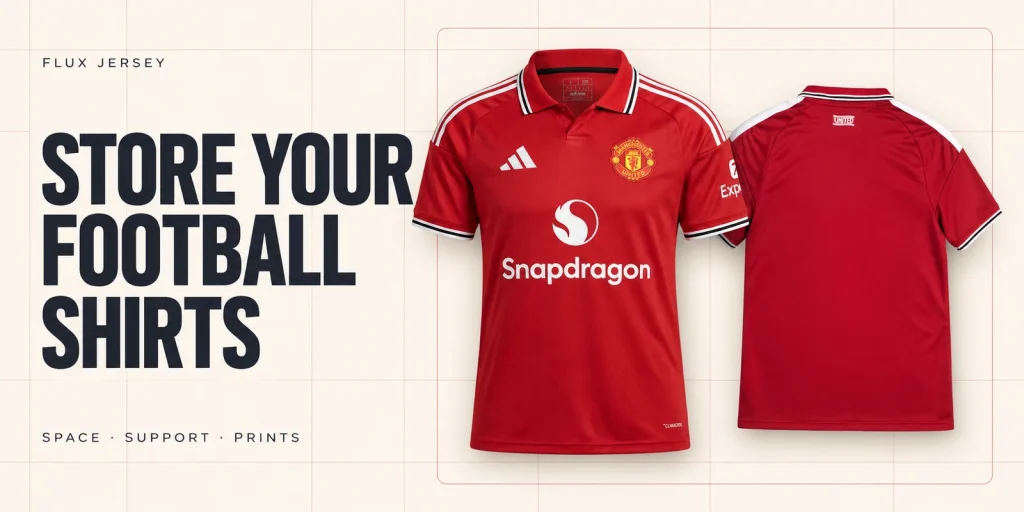
Store football jerseys clean, completely dry and away from strong light, with enough support and space to avoid strained shoulders or hard folds through decoration. For a shirt you wear regularly, a suitable hanger or a roomy drawer can work. For a fragile original, an autograph or deteriorating printing, choose storage around the item’s condition and seek specialist advice before cleaning or rearranging it.
This guide concerns association-football shirts kept at home. It combines textile-care guidance with practical layout examples; it does not report a storage experiment or promise a particular lifespan.
Decide what you are putting away
Start by separating the shirts ready for ordinary wear from pieces that need individual attention. Check the fabric, seams, sponsor, badges and any name or number. A shirt’s condition matters more than whether its listing calls it “retro” or “player”.
For a washable everyday shirt, follow its own care instructions and put it away only when fully dry. Our soccer-jersey washing guide covers that preceding step. Do not turn “store clean” into an automatic instruction to wash a signed or damaged collectible: preserving the object may require a different approach.
The Canadian Conservation Institute’s basic textile-care guidance distinguishes robust items from fragile historic textiles and warns that cleaning damage can be irreversible. Use that guidance to recognise when an item needs individual advice before cleaning.
Match the space to the shirt
A useful first question is whether the garment can hang comfortably or needs support across its whole body. The CCI’s hanging-storage note excludes garments with weaknesses that make hanging unsuitable and describes padded, appropriately shaped hangers and individual dust covers.
- A sound shirt in regular rotation: a suitably sized, wide, padded hanger can make it easy to see and retrieve. Avoid thin wire hangers; check that the shoulders sit on the support without stretching. Leave room to remove it without dragging it through neighbouring garments.
- A shirt that needs fuller support: consider a drawer, tray or box large enough to minimise folding. For a delicate collectible, get advice about the support and lining materials first.
- A crowded space: moving shirts elsewhere is more useful than forcing the drawer shut or squeezing another hanger onto an already packed rail.
Choose a space that accommodates the actual garment. If retrieving one shirt means repeatedly disturbing several others, give it an easier-to-reach position.
Look at both sides before you fold
A blank back does not mean the whole shirt is free of decoration. These Flux catalogue photographs show a large front sponsor and a back without a player name or large number. They illustrate why you should inspect both sides before choosing a fold; they do not establish the print’s material or adhesion.


On this example, the white Snapdragon wordmark occupies the centre of the front. A fold chosen only by looking at the blank back could still cross that front print. For your own shirt, check the proposed fold on both sides before putting it away. If the available drawer makes a hard crease through decoration unavoidable, use more space or fuller flat support instead of forcing the shirt to fit. House of Namesets’ own care guidance advises avoiding sharp folds, prolonged compression and firmly pressed print-to-print contact. That supplier’s advice does not establish identical construction for every Flux item.
For suitable textiles in flat storage, CCI recommends minimising folds and padding unavoidable ones with appropriate material. Its flat-storage note also advises against heavy layering. A container should fit the shirt’s layout; do not assume a container that works for one garment will accommodate another.
Check the box and liner, not just the word “plastic”
“Plastic” is too broad a description to decide whether a container is suitable. CCI’s flat-storage note identifies polyethylene and polypropylene boxes, acid-free card and suitable lining materials, including prewashed cotton or unbuffered acid-free tissue. That is a more specific recommendation than using an unidentified bag simply because it is clear or resealable.
For a heritage piece, ask a conservation supplier about the materials in the whole setup, including its liner. Do not treat shipping packaging as an archival specification or assume that adding tissue makes an already tacky print safe to fold. A shopping label such as “premium storage” is not a substitute for identifying the materials.
Choose a stable location and know when to stop
CCI’s basic-care guidance explains that light damage accumulates, excess moisture encourages mould, and rapid environmental changes can harm textiles. Choose a protected location away from direct light and heat sources, rather than an exposed shelf or a spot with recurring damp.
Check the shirt and its surroundings periodically. If you notice new discolouration, moisture or a change in a print, reconsider the setup. For decoration that becomes tacky, brittle or starts lifting, do not keep folding it to see what happens or add heat as a precaution. House of Namesets specifically flags ageing printing and cautions against unnecessary intervention.
Before you close the wardrobe or drawer, make one final practical check: can you retrieve this shirt without pulling on another, compressing a printed area or forcing the storage unit shut? If the answer is no, change the layout while you can still see the problem.
Sources reviewed 27 October 2026 UTC. CCI’s guidance concerns textile conservation. The cover is an AI-assisted design using Flux catalogue photographs; the body photos show the actual listing. Flux sells football shirts and has not tested this storage setup.