English
 Deutsch
 Español
 Português
 Italiano
 Français

 Manchester United
 Man City
 Tottenham Hotspur
 Aston Villa
 Newcastle United
 Fulham
 Everton
 West Ham United
 Leeds United
 Ipswich Town
 Nottingham Forest
 Crystal Palace
 Brighton
 Wolves
 Atletico Madrid
 Real Betis
 Real Sociedad
 Villarreal
 Napoli
 Roma
 Lazio
 Venezia FC
 Bayer Leverkusen
 RB Leipzig
 Eintracht Frankfurt
 Borussia Dortmund
 AS Monaco
 Olympique Lyonnais
 Marseille
 Chivas
 Tigres UANL
 Monterrey
 Club America
 Cruz Azul
 Pumas UNAM
 Club León
 Ajax
 Sporting
 Boca Juniors
 PSV
 Olympiacos
 FC Porto
 Glasgow Rangers
 New York City
 LA Galaxy
 Orlando City
 Bologna FC
 New York Red Bulls
 Scotland
 Norway
 Austria
 Czech
 Albania
 Sweden
 Greece
 Ireland
 Turkey
 Yugoslavia
 Hungary
 Ecuador
 Venezuela
 Uruguay
 Chile
 Peru
 Japan
 Australia
 Saudi Arabia
 Senegal
 Cameroon
 Morocco
 Nigeria
 Algeria
 Egypt
 Jamaica
 Guatemala
 Panama
 El Salvador
 Real Madrid
 Barcelona
 Fiorentina
 Celtic

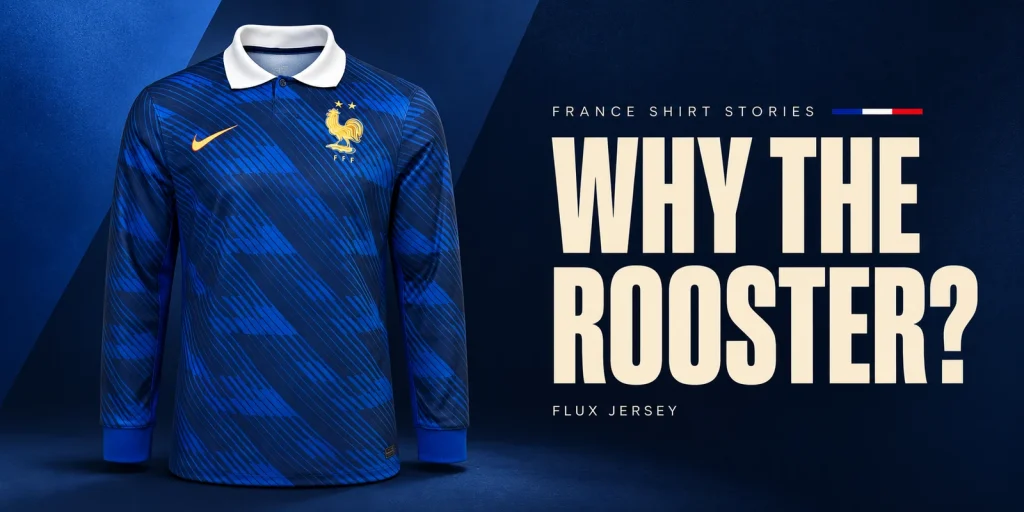
France has a rooster on its football jersey because the Gallic rooster is a long-established symbol of French identity. Its association with France grew from Latin wordplay: gallus could refer to a rooster and to a Gaul. The national team’s crest carries that wider cultural association onto the football shirt.
What the Gallic rooster represents
The French presidency’s history of the rooster traces the connection through coins, royal imagery and the French Republics. It also places the bird in France’s sporting symbolism. The team is using an emblem with a cultural history beyond football.
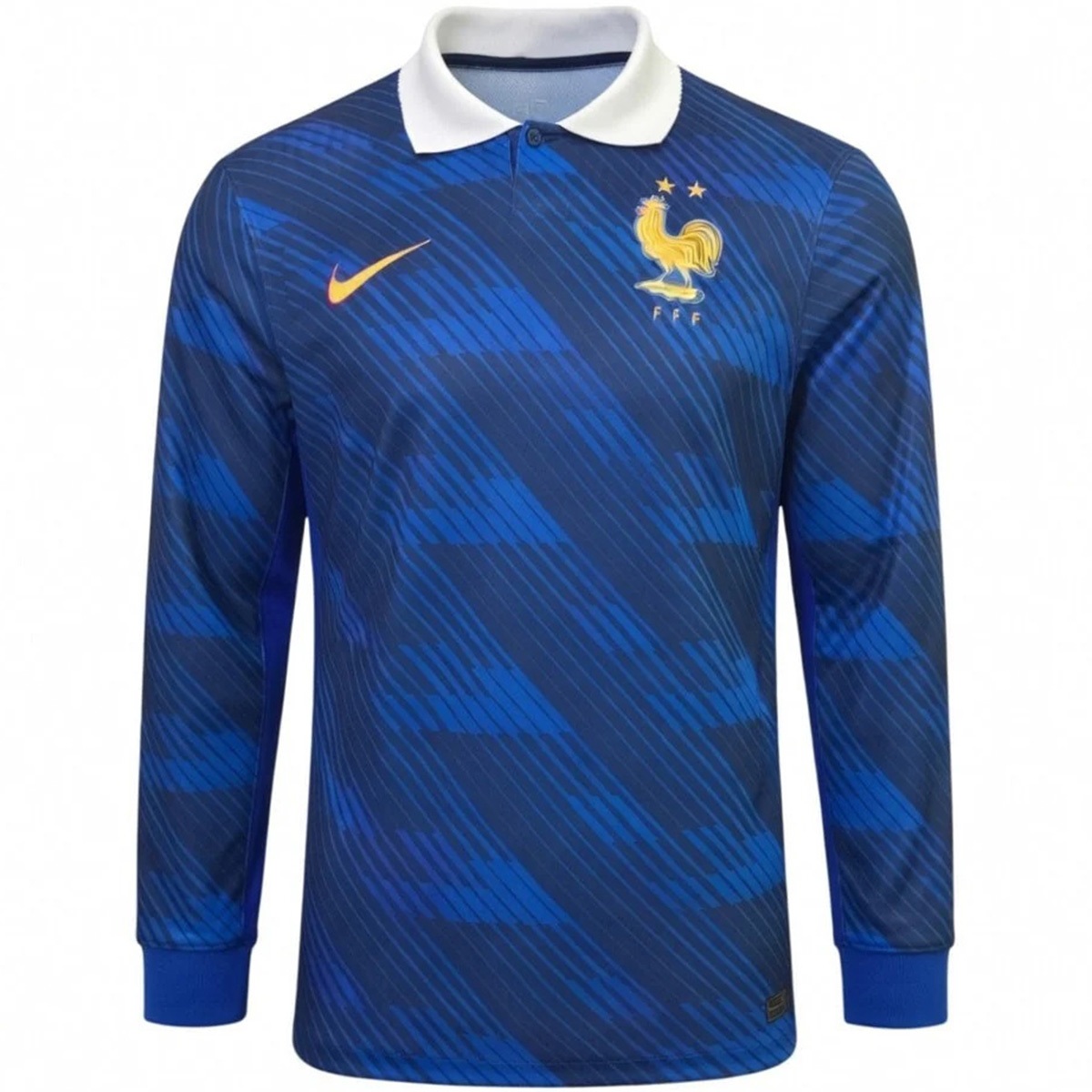
On the catalogue example below, the gold rooster appears above the FFF lettering, while a separate curved sportswear mark sits on the other side of the chest. The bird belongs to the team emblem; it is a different mark from the sportswear logo.
When the rooster reached the football shirt
For a precise football-shirt milestone, the federation supplies a useful record. In its 120th-anniversary history, published on 1 May 2024, the Fédération Française de Football dates the first France shirt bearing the rooster to 31 August 1920. It identifies the match as the Olympic semifinal against Czechoslovakia in Antwerp.
The article also includes an archival image identified as Henri Bard wearing the emblem in 1920. That is the federation’s historical evidence for the shirt milestone. It is separate from a modern shop photograph or a retrospective badge illustration, which cannot by itself establish when an emblem first appeared in a match.
The sources do not all give the same first-shirt date. Footpack’s crest history places the rooster on the football shirt in 1907; the FFF dates that first appearance to 1920. The federation’s explicitly identified match is the milestone used here. These accounts disagree; the earlier date is not treated as the same event or as a resolved alternative.
What the emblem tells you about a shirt
Start by recognising the national symbol, then look at the particular crest and the rest of the garment. The rooster’s presence alone cannot establish a shirt’s manufacturing year, fabric, badge construction or provenance. Those questions require evidence for the individual item.